
How Do You Credit a BDR on an Inbound Meeting?
The rules of engagement most SDR orgs never write down, plus the 23 scenarios I use to settle them.

How Do You Credit a BDR on an Inbound Meeting?
The rules of engagement most SDR orgs never write down, plus the 23 scenarios I use to settle them.
Dave Wilkins
August 21, 2026
How do you credit a BDR on an inbound meeting?
A leader in the community posted a version of this last week, and it turned into one of the most useful threads we've had all year.
His situation will sound familiar.
Reps calling and messaging into accounts owned by other reps. Inbound SDRs booking meetings on accounts the outbound team has been working for weeks. Some of it is caused by an enrichment tool that auto-assigns owners on import and quietly creates duplicates.
But that wasn't the real problem. Here's the line that stopped me:
"The ROE is informal, so every collision turns into a credit dispute that managers argue case by case."
And then, a few messages later:
"These conversations are really de-motivating the reps."
That's the actual cost. Not the duplicate records. The fact that twice a week, two managers have an argument about money in front of the people whose money it is.
Source-based or ownership-based
There are two ways to settle this and most orgs never explicitly pick one.
Source-based credits whoever generated the trigger. The form fill came in, so inbound owns it, regardless of who had been working the account.
Ownership-based credits whoever holds the account. The BDR has been in there for a month, so the meeting is theirs no matter how it arrived.
Both are defensible. Both are also unfair in obvious edge cases, which is why picking one and stopping there doesn't work.
Exclusive VIP deal for our community: ApolloNext
Big news
We partnered with Apollo this year – and one of the perks we negotiated for our community is complimentary access to ApolloNext 2026. This isn't available to the public.
GO TO THIS LINK to register for free.
September 30. SFJAZZ Center. San Francisco. One day with the GTM leaders actually moving the number:
Apollo CEO Matt Curl on where the revenue engine is headed — major announcements included
Operators from Uber, Figma, and beyond on what's working right now
Live on stage: a growth leader builds a real Apollo play from scratch. No slides. No theory.
Strategies you can apply Monday morning
This is the room. You should be in it.
Claim your spot
When: September 30, 2026
Where: SFJAZZ Center, San Francisco

The rule that actually held up
The best answer in the thread came from someone who had run this at a 70 person org, and it splits the difference.
Last meaningful touch, with a 30 day window.
Did the outbound rep have a meaningful touch on that account or contact within 30 days of the inbound activity? If yes, route to them and credit outbound. If no, it goes to inbound.
The word doing all the work there is "meaningful," and this is where most ROE documents fall apart. If you don't define it, you haven't removed the argument, you've just moved it.
So define it. With examples.
Counts as a meaningful conversation: a five minute conversation with a call recording attached.
Counts as consistent engagement: three or more opened emails, ten or more contacts touched at the account, twenty or more logged activities.
Does not count: one generic email blasted to the account. Five no-pickup, no-voicemail dials spread across four weeks.
The null examples matter more than the positive ones. Every rep in your org can tell you what good engagement looks like. What they need to know is exactly where the floor is, because that's the line they'll argue right up to.
The bit almost everyone skips
Write the escalation path before you need it.
The mistake is letting disputes get settled between the inbound manager and the outbound manager. Both of them have a number riding on the outcome. That is not a process, it's a negotiation, and your reps can see that.
Move the ruling to someone inside the business unit but without direct skin in the game. SDR ops, or the SDR director. Not the two people whose teams are competing.
That single change does more for rep trust than any amount of rule-writing, because it turns "my manager didn't fight hard enough for me" into "the rule says what it says."
What I'd do this week
Pick one model, source-based or ownership-based, and write it down.
Add the 30 day meaningful touch override, with three positive examples and three null examples.
Name the person who rules on disputes, and make sure it isn't either manager.
Then go and find the ten collisions from last quarter that caused the most friction, and run them through the new rules. If the answers still feel wrong, your definitions are wrong, and it's much cheaper to find that out on historical cases than on live ones.
Steal my scenario sheet
I keep a spreadsheet of 23 credit scenarios with the ruling for each one. Inbound on an outbound-worked account, partner-sourced, self-service upgrade, meeting booked by an AE off a BDR sequence, the lot.
It's the thing I wish someone had handed me the first time I inherited an argument about this.
If you've got scenarios that aren't on it, reply to this email and tell me. I'll add them and send the updated version out.
Meet in Real Life Next Week
Come and join us at our upcoming in-person events in the USA; check out www.sdrleaders.global for our global agenda of upcoming events!
25th Aug: Denver
25th Aug: New York City
27th Aug: Toronto
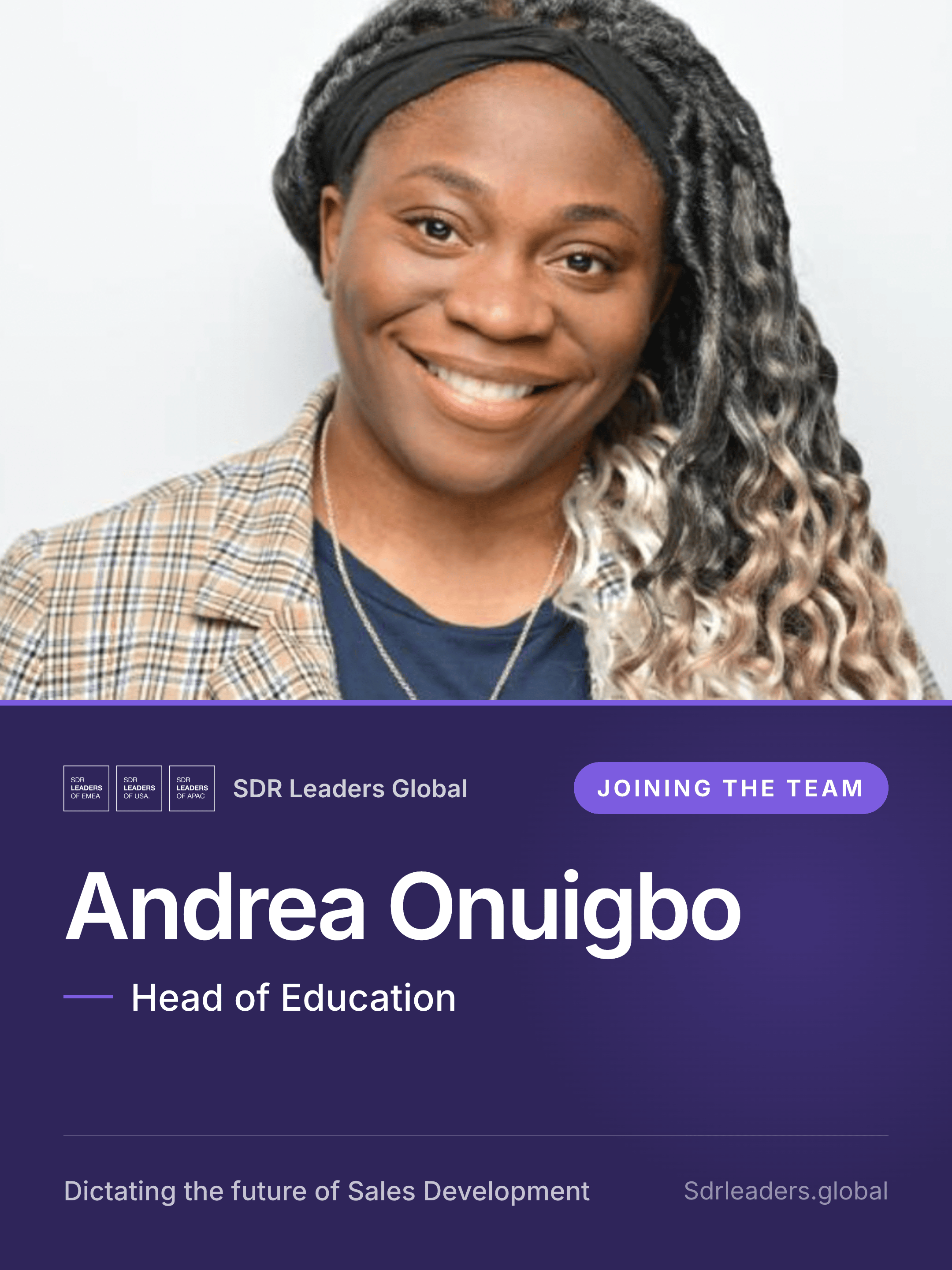
Community news: Andrea Onuigbo joins as Head of Education
One announcement I want to make properly.
Andrea Onuigbo has joined SDR Leaders Global as our Head of Education.
Andrea spent a decade running sales development at Oracle, Atlassian and Snowflake, leading teams across EMEA and APAC. More than 70 SDRs, AEs and managers coached one to one. Her focus has always been the transition nobody prepares you for, the one from being good at the job to being responsible for other people doing it.
I worked alongside her at Snowflake. She is one of the best leaders and teachers I have ever met, and that is not a line I write lightly.
She's building the SDR Leader Accelerator, launching in the next few weeks. Not theory. The decisions you actually face, including this one.
Andrea, thrilled to have you here. More news soon.